Online Poker UK: A Proper Guide to Sites, Rules, Strategy and Safer Play
Online poker is easy to find in the UK. Good poker information is harder.
Search results are full of the same soft claims: big bonuses, trusted sites, fast payouts, huge tournaments. Some of it is useful. A lot of it feels written by someone who has never sat through a cold run of cards, misread a bonus term, or realised too late that the tournament they entered will finish at 2 a.m.
Top-Casino-Poker.com is built for a more practical kind of player. Maybe you are learning Texas Hold’em from scratch. Maybe you already play small-stakes tournaments and want better site comparisons. Maybe you are checking whether a poker room is licensed, how rake works, or whether that bonus is worth the trouble. The aim here is not to make poker sound risk-free. It is to explain the game, the market, and the small details that actually affect your session.
Poker is not slots with cards. It is also not a guaranteed skill income. It sits somewhere more awkward and more interesting: skill matters, discipline matters, but variance still has teeth.




UK Online Poker Starts With Licensing
The UK is a regulated gambling market. That is the first thing to get right.
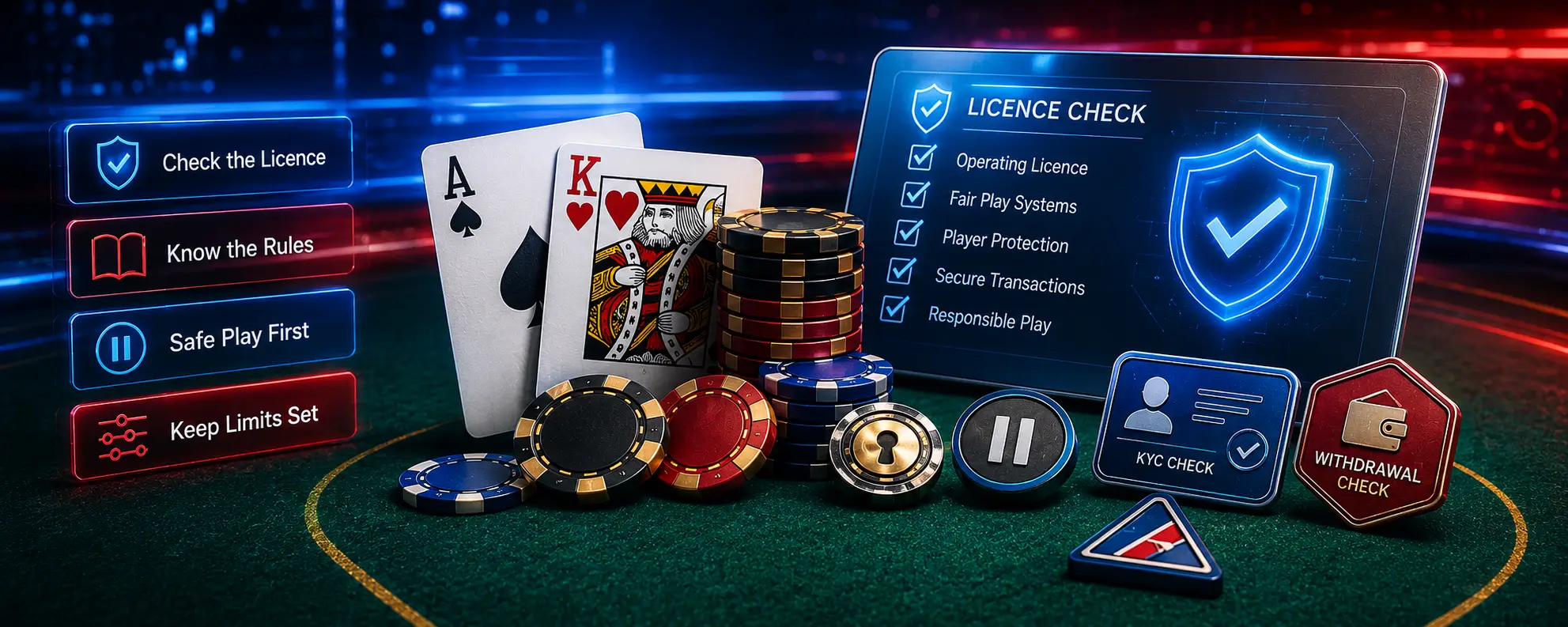
A poker site offering real-money games to customers in Great Britain should be licensed by the UK Gambling Commission. For poker, this usually sits under remote casino licensing, because online poker is regulated alongside other remote casino products. A licence does not magically make a site perfect, but it gives you something important: rules, oversight, identity checks, safer gambling requirements, complaint routes, and a basic standard of consumer protection.
That is why “licensed in the UK” matters more than a flashy lobby.
Unlicensed offshore poker rooms may still appear in search results. Some may promote crypto, bigger bonuses, fewer checks, or access outside UK self-exclusion systems. Those selling points should make you slower, not more excited. If a site is avoiding the UK framework, the player usually carries more risk when something goes wrong.
A proper poker review should check the licence before praising the tournament schedule. If the legal position is muddy, everything else is decoration.
What People Usually Mean by Online Poker
The phrase online poker gets used too broadly. One player may mean real-money cash games. Another may mean a free app for learning hand rankings. Someone else may be looking for tournament strategy before playing live at a casino.
Those are different needs.
| Type of poker | What it means in real use | Who it suits | What to check |
|---|---|---|---|
| Real-money online poker | Cash tables, tournaments and sit-and-gos with deposits and withdrawals | Players ready for regulated gambling | UKGC licence, rake, KYC, withdrawal rules |
| Free online poker | Play-money games, practice tables or social apps | Beginners learning the flow | Whether it stays genuinely free |
| Poker apps | Mobile poker rooms, training apps or quick-play formats | Short sessions, casual practice, mobile users | Stability, limits, cashier rules |
| Live poker | Casino rooms, clubs and venue tournaments | Social players and tournament fans | Rake, structure, ID, venue rules |
| Training tools | Odds calculators, range charts, solvers, hand reviews | Players trying to improve | Accuracy, cost, difficulty level |
This is why one “best poker site” list rarely works for everyone. A strong tournament player may care about Sunday guarantees and satellite routes. A beginner needs a clean interface, clear rules and low-pressure practice. A cash-game regular will ask about rake before almost anything else.
The right choice depends on the kind of poker you actually intend to play.
The First Review Test: Does the Poker Room Feel Real?
A lot of gambling sites technically have poker. That does not mean poker is the centre of the product.
Sometimes poker is tucked away behind casino games and sports betting. The page exists, but the traffic is thin. You open the lobby and find a handful of tables, awkward stakes, or tournaments that do not suit UK evening hours. That is not useless, but it is not the same as a proper poker room.
The signs of a serious poker site are fairly easy to spot:
- Cash tables are active at normal stakes.
- Tournament schedules are clear and updated.
- Rake is visible, not hidden behind vague wording.
- The app or desktop client feels stable.
- Hand histories and table filters are easy to use.
- Withdrawals are explained before you deposit.
- Responsible gambling tools are not buried.
- Support can answer poker-specific questions.
That last one is underrated. Generic casino support often struggles with poker details. If support cannot explain rakeback, ticket expiry, tournament cancellation rules or withdrawal checks, the site may not be built with poker players in mind.
Texas Hold’em Is Still the Main Door In
Most UK players start with Texas Hold’em. It is the version people see in tournaments, poker streams, casino rooms and mobile apps. The rules are simple enough to learn quickly. Playing well is another matter.
Each player receives two private cards. Five community cards are dealt across the flop, turn and river. You make the best five-card hand, or you win before showdown by making everyone else fold.
That explanation fits on a napkin. The real game does not.
The real game is position, stack size, bet sizing, board texture, opponent type, pot odds and emotional control. Beginners often focus only on their own hand. Better players think in ranges. They ask what hands their opponent can have, what story the betting tells, and whether the price makes sense.
Basic poker hand rankings
| Rank | Hand | Example |
|---|---|---|
| 1 | Royal flush | A-K-Q-J-10 of the same suit |
| 2 | Straight flush | 9-8-7-6-5 of the same suit |
| 3 | Four of a kind | Four queens |
| 4 | Full house | Three kings and two tens |
| 5 | Flush | Five cards of the same suit |
| 6 | Straight | Five cards in sequence |
| 7 | Three of a kind | Three eights |
| 8 | Two pair | Aces and sixes |
| 9 | One pair | Pair of jacks |
| 10 | High card | Ace high with no made hand |
Hand rankings are the grammar of poker. They tell you what beats what. They do not tell you whether calling a river shove with second pair is clever or just curiosity dressed up as strategy.
Cash Games Are Simple Until They Are Not
Cash games look clean. You sit down with money, play hands, and leave when you want. Blinds stay fixed. Chips are not tournament chips; they represent real value.
That freedom is nice. It is also dangerous.
In a tournament, one bad decision may end your event. In a cash game, bad decisions can repeat for hours. Calling too wide from the blinds, overplaying top pair, chasing weak draws, bluffing people who do not fold, reloading while annoyed — these are not dramatic mistakes. They are ordinary leaks. Ordinary leaks are expensive because they happen again and again.
Cash games suit players who like deeper stacks and patient decisions. They are less suitable for anyone who needs constant action to stay interested. If folding feels like a personal insult, cash games will punish that.
The least glamorous cash-game skill is table selection. Good players leave bad tables. Ego keeps weak players seated.
Tournaments Feel Bigger, But Variance Is Brutal
Poker tournaments are easy to love. One buy-in. A visible prize pool. A shot at a deep run. Even small tournaments can feel like an event rather than a grind.
They are also high variance.
You can play well and bust before the money. You can lose a flip at the wrong time. You can get coolered near the bubble. You can spend four hours building a stack, then lose two hands and be out. That is not a sign the site is cheating. It is tournament poker.
The structure matters more than the banner. A slow blind structure gives better players room. A turbo can become push-fold quickly. Re-entry events change the feel of the field because aggressive players can fire again. Big late registration windows can be annoying if you prefer a cleaner tournament shape.
Before joining a tournament, check the boring details:
- buy-in and tournament fee;
- starting stack;
- blind level length;
- late registration period;
- re-entry rules;
- payout structure;
- expected finish time;
- whether tickets have expiry limits.
The finish time deserves more attention than it gets. A player who registers late at night and gets tired near the money is not unlucky. They planned badly.
Sit-and-Gos, Fast Poker and Quick Formats
Not every poker session has to last three hours. Sit-and-gos, fast-fold poker, short-handed tables and jackpot-style games exist because people want shorter bursts.
They can be fun. They can also encourage sloppy habits.
Fast-fold poker removes waiting time, which sounds great until you realise it also removes natural pauses. You fold and instantly get another hand. That can turn a normal session into autopilot. Jackpot sit-and-gos add lottery-style prize pools, which can make players focus on the rare big multiplier rather than the actual decision quality.
Short formats are not beginner-proof. They often require wider ranges, quicker adjustments and better emotional control. If you are still learning, treat them as sharper tools rather than easier games.
Free Online Poker Has a Place
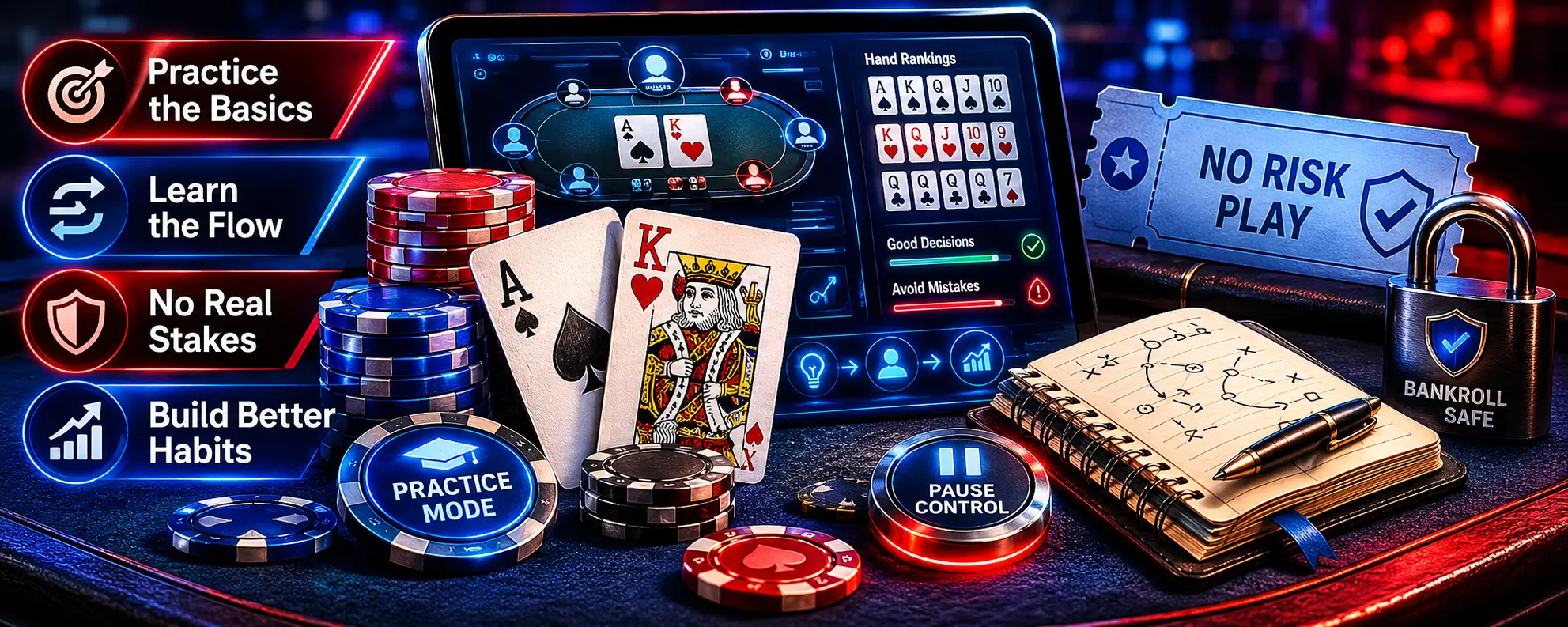
Free online poker is useful. It teaches the order of play, blinds, hand rankings, betting rounds and basic table rhythm without costing money. For a new player, that is valuable.
It also creates strange habits if you take the results too seriously.
Play-money tables do not behave like real-money games. People call too much. They shove nonsense. They chase every draw. They bluff in spots where nobody folds. Winning there does not prove much. Losing there does not prove much either.
Use free poker for mechanics. Use low-pressure study for strategy. Do not walk from a free app into a real-money game thinking the two are the same animal.
Poker Apps in the UK: Convenient, Maybe Too Convenient
A good poker app should feel almost invisible. Clear cards. Sensible bet buttons. Fast loading. No awkward cashier screens. Easy limit tools. No misclick traps. That is what matters.
Mobile poker is useful because it fits into smaller gaps. It is also risky for the same reason. Playing on a phone can make money feel less real. A hand during a commute becomes a tournament in bed. A quick session after work becomes two hours of chasing a cooler.
UK players should also remember that regulated poker apps involve checks. Age and identity verification are part of the market. Credit card gambling is banned. A site that tries to make gambling feel frictionless at all costs is not necessarily doing you a favour.
Convenience is good. Too much convenience can make bad decisions faster.
Bonuses, Rakeback and Tickets
Poker bonuses are not like slot free spins. They usually depend on volume. You may need to generate rake, collect points, enter specific tournaments, or clear rewards over time.
That is why the biggest question is not “How big is the bonus?”
The better question is “Would I play this much anyway?”
If a reward pushes you into higher stakes or longer sessions, the offer is already working against you. Rakeback can be useful for regular players, but it should not become an excuse to grind tired. Tournament tickets can be good value, but only if the events suit your level and schedule.
Check these details before claiming anything:
- Does poker count fully towards the offer?
- Is the reward cash, bonus balance, ticket credit or points?
- How long do you have to clear it?
- Do withdrawals cancel pending rewards?
- Are certain games excluded?
- Are tickets tied to specific tournaments?
- Is there a max bet, max win or account restriction?
- Does the offer suit your actual stakes?
A small clear reward is better than a huge one that changes how you play.
Rake Is the Quiet Opponent
Rake is the fee taken by the poker room. It matters because poker is player-versus-player. You are not trying to beat the house directly, but the house still takes a cut from the game.
At low stakes, rake can be heavy. A player may feel they are playing roughly break-even poker while the rake quietly turns that into a loss. This is why rakeback and loyalty rewards can matter for regulars. It is also why low-stakes players need to be realistic about margins.
A poker room should make rake easy to understand. If you cannot find the fee structure, that is not a tiny missing detail. It affects every session.
Payments and Withdrawals Tell You a Lot
Deposits are rarely the problem. Gambling sites are usually very good at accepting money. Withdrawals are where the real test starts.
A UK poker site should be clear about accepted payment methods, withdrawal routes, identity checks and expected timeframes. Verification should not feel like a surprise. Licensed operators need to check age and identity before gambling, and further checks may happen depending on account behaviour, payment method or regulatory requirements.
| Payment method | Deposit feel | Withdrawal feel | UK poker note |
|---|---|---|---|
| Debit card | Usually quick | Often 1–3 business days | Common, but check whether withdrawals return to card |
| Bank transfer | Less instant | Can suit larger withdrawals | May take longer, but can be practical |
| PayPal | Smooth where available | Often faster than bank transfer | Availability depends on the operator |
| Skrill / Neteller | Fast and poker-friendly | Often quick | Some bonuses may exclude e-wallet deposits |
| Apple Pay | Very convenient on mobile | Cashout may need another route | Check withdrawal rules first |
| Paysafecard | Useful for deposits | Weak for withdrawals | Usually needs a separate cashout method |
Do not judge a cashier by deposit speed alone. A site that makes depositing effortless but withdrawals unclear deserves caution.
Live Poker UK Still Matters
Online poker is efficient. Live poker has texture.
A live table moves slower. You see chip handling, posture, timing, speech, frustration and confidence. None of these reads are magic, and beginners often overrate them, but the social layer is real. Live poker also teaches patience because you cannot just open another table when bored.
UK live poker can mean casino rooms, local poker clubs, organised tournaments or social games. The quality varies. A well-run small event can be better than a bigger tournament with a poor structure. Rake, staff consistency, blind levels and payout rules matter more than room decor.
If you are moving from online to live, prepare for the pace. You will play fewer hands. You will wait more. You will also have more time to notice who is splashing around, who is scared of busting, and who has not played a hand in forty minutes.
Strategy for Beginners: Stop Bleeding First
New players often want clever moves too early. They want bluffs, hero calls and advanced lines. Most beginners would improve faster by removing the obvious leaks.
Start here:
- Play fewer weak hands from early position.
- Stop limping because you “want to see a flop”.
- Raise with a reason.
- Learn pot odds before chasing draws.
- Fold more rivers against passive players who suddenly bet big.
- Do not bluff people who clearly hate folding.
- Take notes after sessions, not just after bad beats.
- Leave when tired.
This sounds basic because it is. Basic poker done consistently beats creative poker done badly.
Position Is the Lesson That Changes Everything
Position is not a side topic. It is the game.
Acting last gives you more information. You see who checks, who bets, who looks uncomfortable, who gives up. The same hand can be fine on the button and awkward under the gun. Beginners often judge cards as “good” or “bad” by themselves. Better players judge cards by position, stacks and opponents.
Once position clicks, hand charts stop looking random.
Bankroll Management Is Boring Until You Need It
Poker players love talking about hands. They talk less about bankrolls because bankroll management feels unexciting. It is also one of the few things that keeps poker from turning into stress.
Do not play with money needed for bills, rent, food, credit payments or savings. Keep poker money separate. Set a session limit before playing. If losing the buy-in would bother you for more than the session itself, the stake is too high.
Tournament players need extra caution because variance is ugly. Cash-game players need reload discipline. Fast-format players need time limits. Different leaks, same principle.
What We Look For in a UK Poker Site
A strong poker site is not always the loudest one. The best rooms tend to get the basics right.
The lobby is readable. The filters work. The tournament schedule is not a mess. The rake information is visible. The mobile app does not freeze during big pots. The cashier explains withdrawals clearly. Support understands poker terms. Safer gambling tools are easy to find.
Weak sites often fail in small ways first. Too many pop-ups. Confusing bonuses. Thin traffic. Slow support. Vague withdrawal wording. A mobile table that feels cramped. None of these alone ruins a site, but together they tell you the product was built more for sign-ups than sessions.
That is the difference this site focuses on.
Mistakes UK Poker Players Keep Making
Some poker mistakes never go out of fashion.
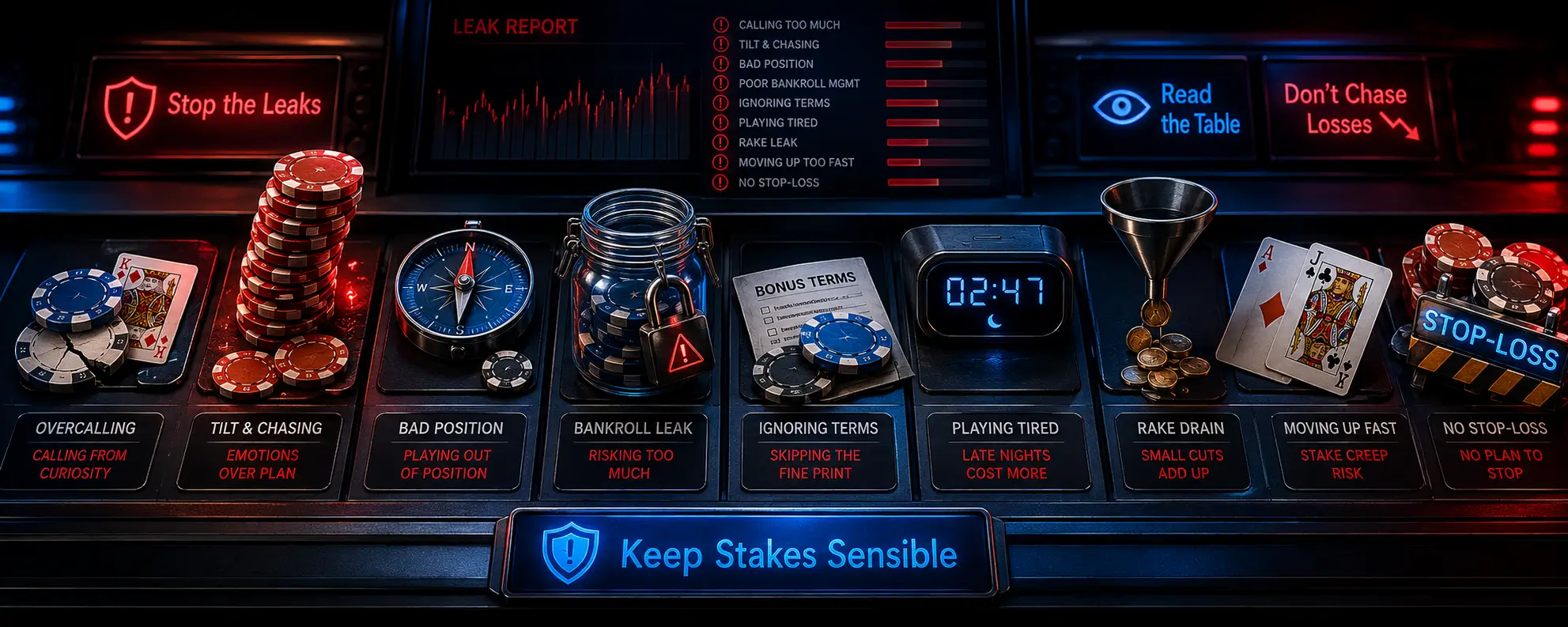
Players call because they are curious. They chase losses. They move up after one good session. They ignore rake. They enter tournaments they do not have time to finish. They claim bonuses without reading the terms. They confuse being unlucky with playing well. They trust a site because the homepage looks expensive.
The worst mistake is playing emotionally and explaining it afterwards. Poker gives you plenty of language to justify bad decisions. “I had blockers.” “He could be bluffing.” “I was priced in.” Sometimes true. Often just a story.
A useful poker guide should make those stories harder to believe.
Safer Gambling: Skill Does Not Remove Risk
Poker players sometimes act as if safer gambling advice is only for casino games. That is wrong.
Poker has skill, but it also has variance, pressure, ego and long losing runs. A strong player can lose for weeks. A weak player can win a tournament and think they have solved the game. Both situations can lead to poor decisions.
Treat poker as paid entertainment, not income. Set limits before the session starts. Do not chase. Do not play tired, drunk or angry. If poker starts affecting sleep, work, relationships or money outside the game, stop and speak to someone.
UK players can contact the National Gambling Helpline on 0808 8020 133. It is free, confidential and available 24/7. GamCare also provides support and advice for people affected by gambling harm.
Hard limits are not weakness. They are part of playing properly.
Who Top-Casino-Poker.com Is For
This site is for UK players who want poker explained without the usual noise.
Beginners can use it to learn rules, hand rankings and basic strategy. Casual players can compare formats and understand which games fit their habits. Tournament players can think more clearly about structure, tickets and variance. Mobile users can check whether an app is actually usable. More experienced players can look at rake, traffic, rewards and withdrawal details before trusting a room.
The goal is not to tell every reader to sign up somewhere. Sometimes the better answer is to practise for free. Sometimes it is to play live. Sometimes it is to skip a bonus. Sometimes it is to close the app and come back tomorrow.
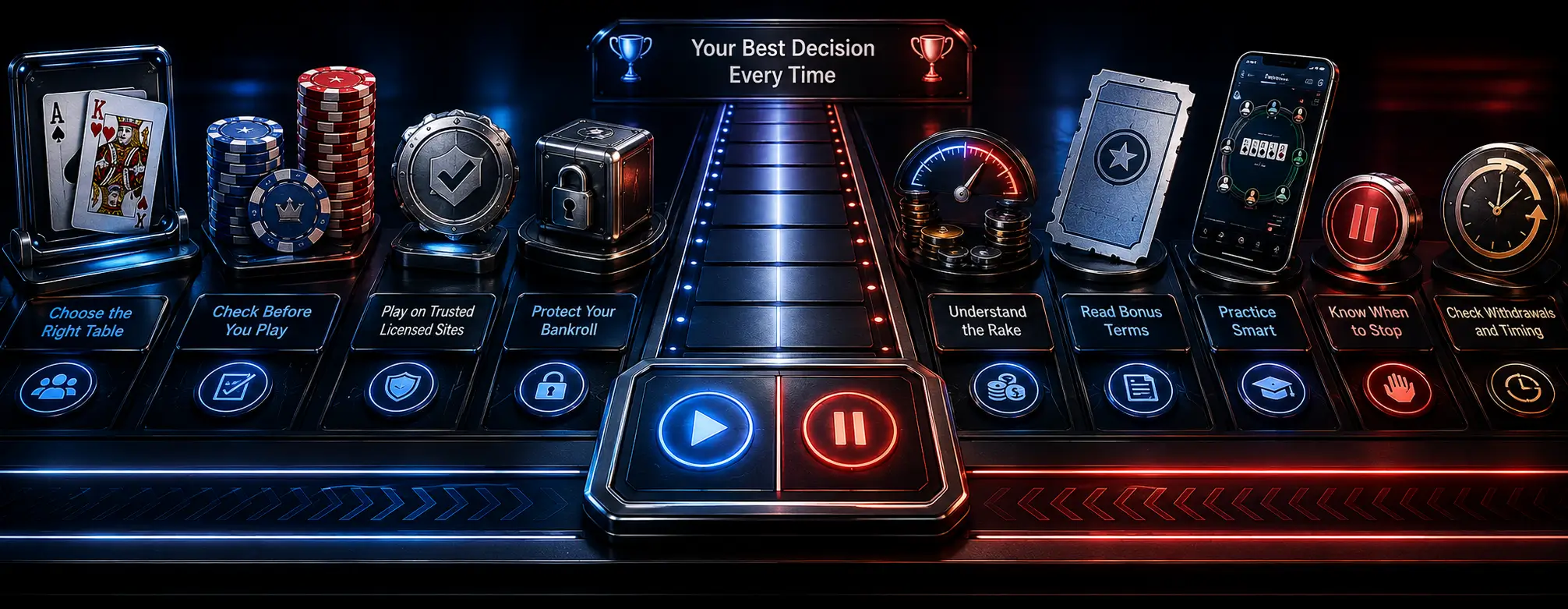
Good poker decisions often happen before the cards are dealt.
FAQ
Is online poker legal in the UK?
Yes, online poker can be legal in the UK when offered by an operator licensed by the UK Gambling Commission. UK players should check the licence before registering, especially if the site looks unfamiliar or promotes unusually loose access.
What should I check before joining a poker site?
Start with the licence, then check rake, game traffic, tournament schedule, withdrawal rules, payment methods, support quality and safer gambling tools. A good bonus cannot fix a weak poker room.
Can I play online poker for free?
Yes. Free poker games and practice apps are useful for learning rules and table flow. Just do not treat play-money results as proof of real-money skill, because free tables behave very differently.
Are poker bonuses worth it?
Some are, but only if the terms fit your normal play. If a bonus makes you play longer, higher or in formats you do not understand, it may cost more than it gives back.
What is rake in poker?
Rake is the fee taken by the poker room. It can be a percentage of cash-game pots or part of a tournament fee. Low-stakes players should pay attention to it because rake can eat into small edges.
Is mobile poker safe?
Mobile poker can be safe on licensed UK sites, but it can also make sessions too casual. Use deposit limits, time-outs and clear stop points. A good app should make safer gambling tools easy to find.
Can UK players use credit cards for poker?
No. Credit card gambling is banned in the UK. Licensed operators should not accept credit cards for online poker deposits.
Do poker sites need to verify my identity?
Yes. UK-licensed gambling operators must verify age and identity before allowing gambling. Extra checks may still happen later, especially around payments or account activity.
Is live poker better than online poker?
Not better, just different. Live poker is slower and more social. Online poker is faster and more convenient. Live games may suit players who like table atmosphere, while online poker suits players who want more volume and flexible sessions.
Where can UK players get help with gambling problems?
UK players can contact the National Gambling Helpline on 0808 8020 133. GamCare also offers confidential support, live chat and practical advice.